Before you go
- Vehicle
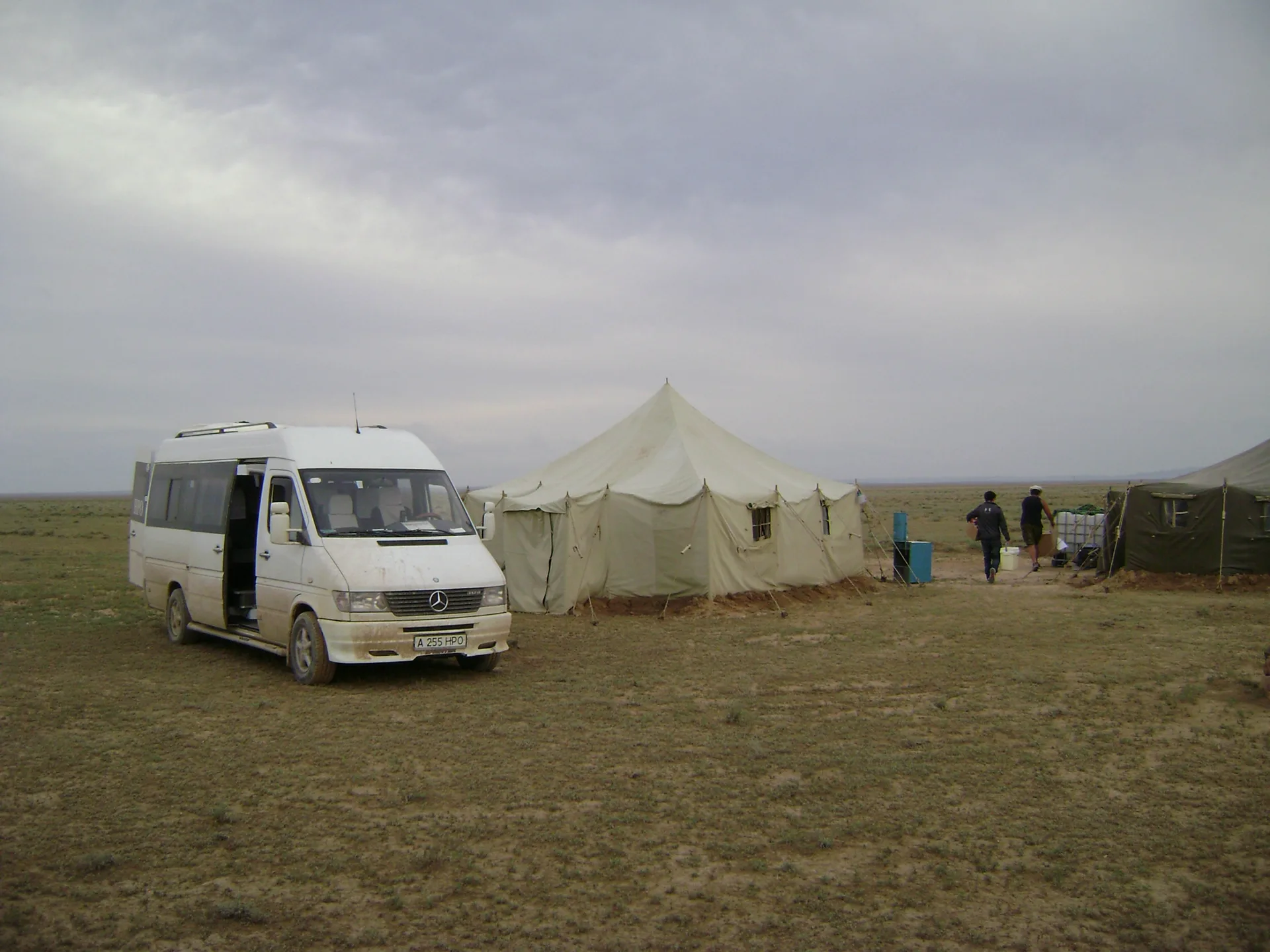
- 4×4 required
- Permit
- Required — Entry to Altyn-Emel requires registration at the park headquarters in Basshi village (2 Mametova St., open daily 08:00–17:30 with a lunch break 13:00–14:30). Each route requires a separate permit. As of late 2023, fees were approximately 2,500 KZT per person per day plus 200 KZT for a vehicle. Payment is cash only. Permits can be arranged in advance at the Almaty branch office (Bogenbai Batyr 132, office N305A). A park-assigned guide is required for all interior routes; guide fees are negotiated on-site. For the Besshatyr or Shengeldy western entrance, pre-arrange permits before arrival — there is no permit office at that checkpoint.
- Entrance fee
- Approximately 2,500 KZT per person per day plus 200 KZT for the vehicle (as of 2023). Cash only, no ATMs inside the park or in Basshi.
- Peak altitude
- 951 m
- Cell coverage
- None
- Fuel
- Fill up in Saryozek (~180 km from Almaty) or the petrol station at the outskirts of Basshi before entering the park. No fuel is available inside the park. Basshi's in-village station can be unreliable — treat Saryozek as the guaranteed last stop.
- Road status
- The A3/A353 highway from Almaty to Konaev and on to Saryozek is paved and in reasonable condition. The road from Saryozek to Basshi via the Altyn-Emel mountain pass is partially paved with rough sections. Inside the park all tracks are gravel, sand or bare rock; the Aktau and Singing Dune loops are particularly rough. A 4x4 with high clearance is required beyond Basshi. Sharp desert rocks puncture standard tyres — carry a repair kit and a spare.
- Closed months
- Jan, Feb, Dec
About this trip
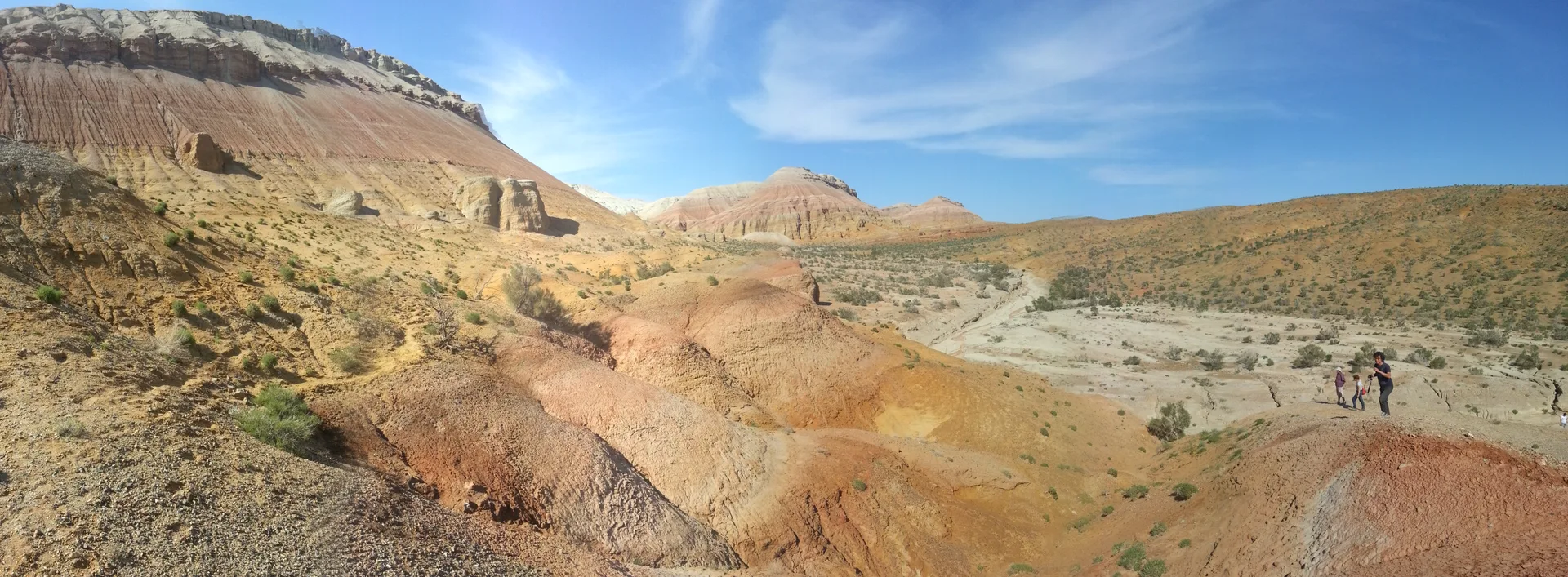
Altyn-Emel stretches across 460,000 hectares of Zhetysu desert between the Ili River and the Tian Shan foothills — a landscape of stacked geological time. The Singing Dune (Поющий Бархан) is the showpiece: a 3-km-long, 150-m-tall barchan of pure quartz sand that emits a resonant, organ-like drone when dry grains shift down its face. The Aktau White Mountains, just 50 km away, look like a different planet — layered Paleogene sediments in white, red, blue and green rising from the valley floor, preserving rhinoceros and crocodile fossils from 25–30 million years ago.
The park also holds the Katutau volcanic highlands (solidified basalt flows above 900 m) and the Besshatyr necropolis, 31 Saka royal burial mounds dating from the 6th–4th centuries BC. A UNESCO World Heritage nomination was submitted in 2023. Entry is through the village of Basshi, where the park headquarters issues permits and can assign a park guide. A guide is recommended for the rougher interior tracks, though the main routes to the Singing Dune and Aktau are commonly driven self-guided — confirm current requirements when you register.
Because key sites are spread 50–80 km apart on unpaved tracks, two days is the practical minimum to see the Singing Dune and Aktau together. A single long day from Almaty reaches the Singing Dune only. There is no public transport to Basshi, and cell signal drops to nothing inside the park, so offline maps (2GIS or Maps.me) and downloaded GPS tracks are essential.
Route
Skip map, jump to step listWhere to sleep
- Night 1 of 1Gostinitsa Altyn-EmelGuesthouseBudget
Budget · ~8–15k KZT/night. Mid-range · ~15–40k KZT. Premium · ~40k+ KZT.
Itinerary
Stop 1
Almaty
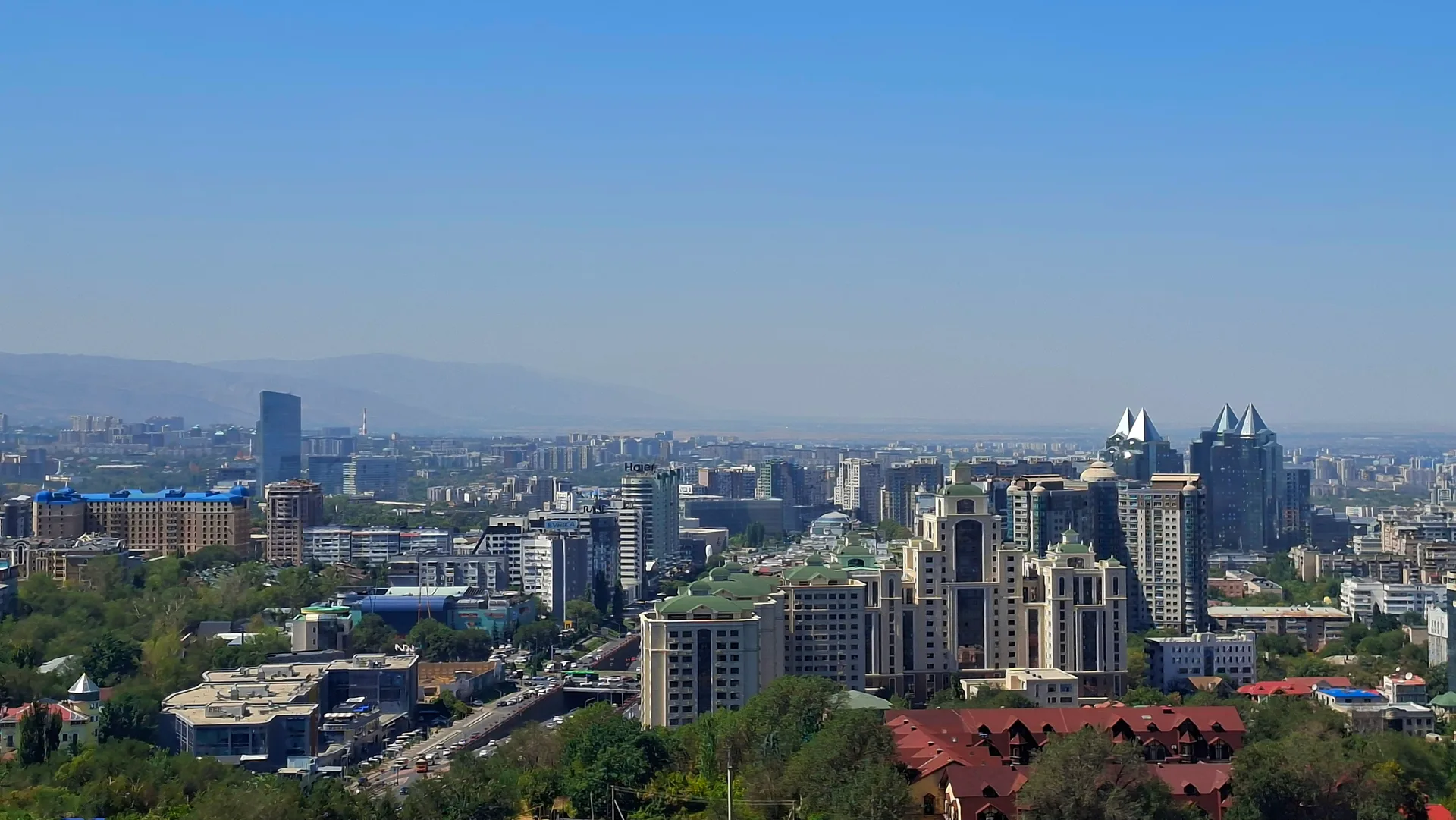
Leave Almaty early — 05:30–06:00 is ideal — to make the most of the day and avoid midday heat on arrival. Take the A3 north past the Kapchagai reservoir, then the A351 east through Konaev (formerly Kapchagai city) toward Saryozek. The road is paved and moves quickly. Fill the tank before leaving the city and again at Saryozek, ~180 km into the drive, which is the last certain fuel stop before Basshi. The total drive from Almaty to Basshi park headquarters runs around 295 km and takes roughly 4 to 4.5 hours without stopping.
Tip: Download 2GIS offline maps for Zhetysu Region before leaving Almaty — cell signal is unreliable after Saryozek and non-existent inside the park. Bring enough KZT cash for two days of permits, guide fees, accommodation in Basshi, and meals.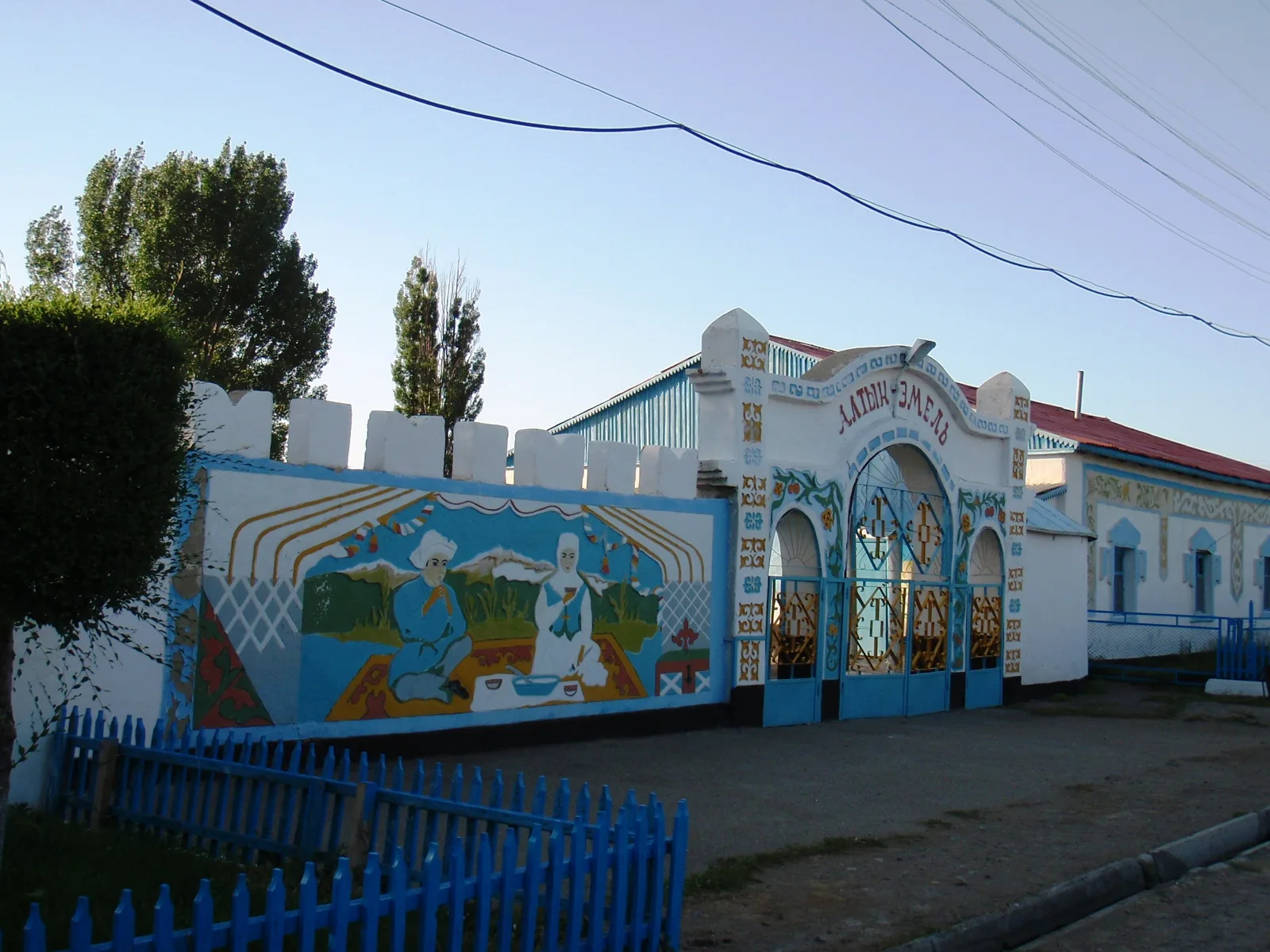
Stop 2
Basshi Village — Park Headquarters
- From previous:
- 295 km · 270 min drive
- Stay:
- ~1 h
Basshi is the park's administrative hub and the only entry point for the main routes to the Singing Dune and Aktau Mountains. The headquarters (2 Mametova St.) issues route permits and can assign a park guide — recommended for the rougher interior tracks, though the Singing Dune and Aktau routes are commonly self-driven; confirm requirements when you register. Budget 30–60 minutes for the paperwork. The village has a small grocery store and basic guesthouses charging 5,000–10,000 KZT per person with meals included — book ahead in high season. Beyond the permit office, Basshi is the last place to buy supplies, use a phone signal, or access a basic vehicle workshop.
Tip: The permit office closes for lunch 13:00–14:30 and shuts at 17:30. Arriving before noon gives you time to complete registration and still reach the Singing Dune with afternoon light. Call ahead (+7 72840 45209) if your arrival may be late.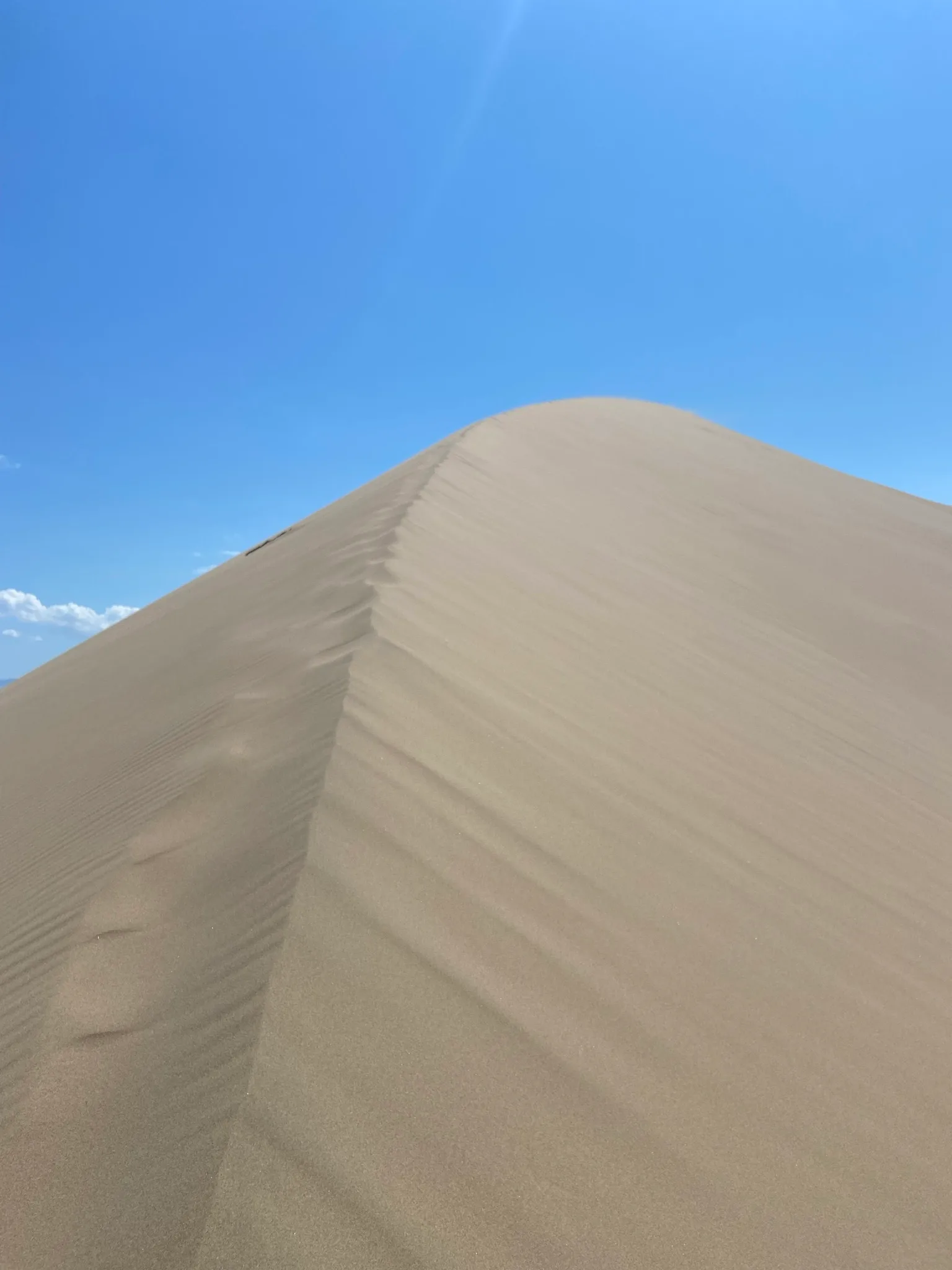
Stop 3
Singing Dune (Поющий Бархан)
- From previous:
- 50 km · 90 min drive
- Stay:
- ~3 h
The Singing Dune rises abruptly from the flat steppe like a sand mountain — 3 km wide, 150 m tall, formed from pure quartz grains deposited by ancient winds into a crescent barchan shape. Climbing the slip face takes 20–40 minutes of calf-burning effort in loose sand. At the crest the views extend across the Ili valley and the flat-topped Katutau range. When conditions are right — dry, with a westerly breeze — the sand produces a low, resonant drone audible from several hundred metres. The phenomenon occurs when dry grains avalanche down the steep lee face and friction between grains generates sound waves at around 100 Hz.
Tip: Bring gaiters or close-toe shoes that can be sand-sealed — the fine quartz sand works into everything. Avoid climbing in midday summer heat (June–August); early morning or late afternoon is cooler. The dune 'sings' best on dry, breezy afternoons.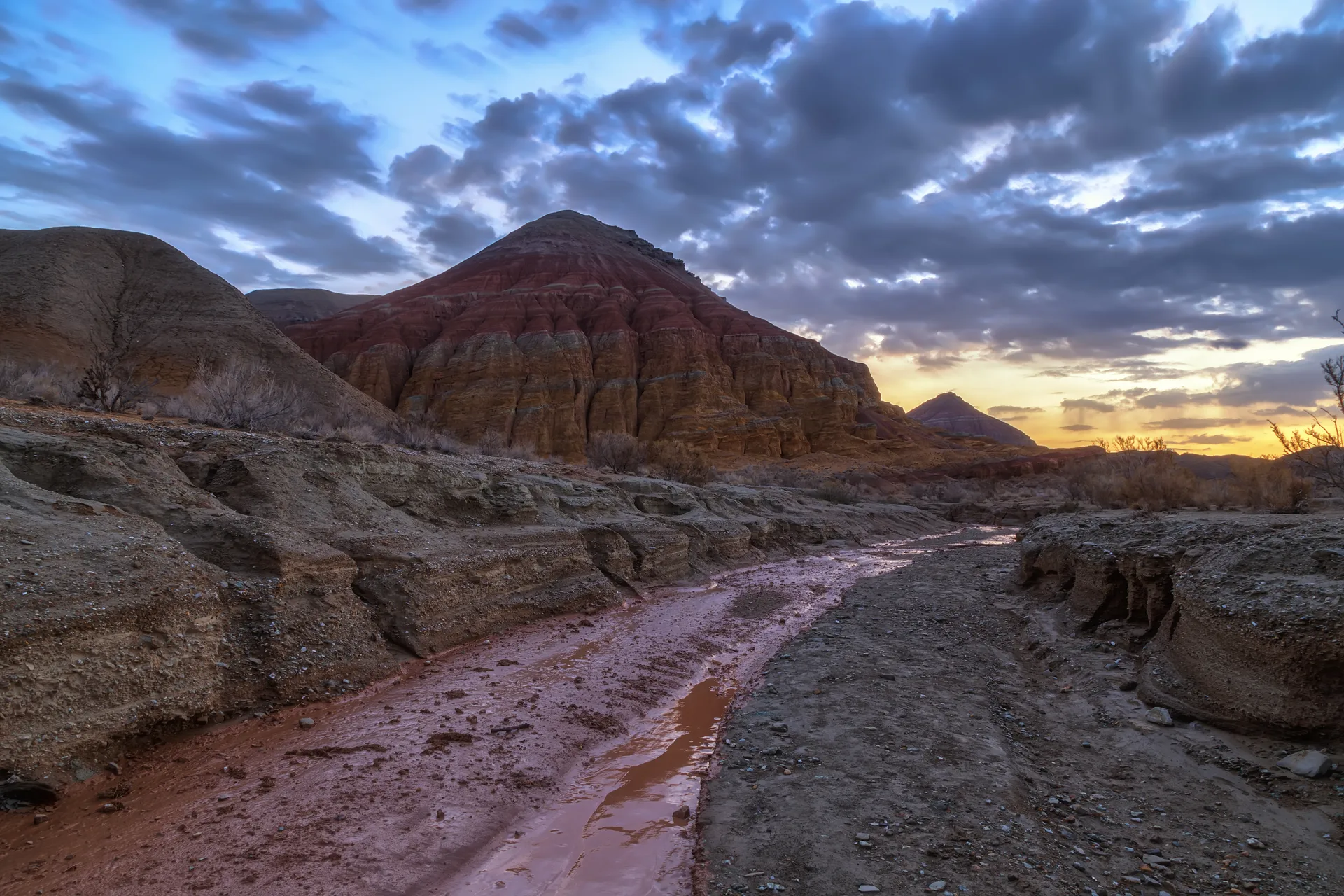
Stop 4
Aktau White Mountains
- From previous:
- 55 km · 90 min drive
- Stay:
- ~3 h
The Aktau range — the name means 'White Mountains' in Kazakh — is a 30-km-long escarpment of Paleogene and Neogene sedimentary rock along the right bank of the Ili River. The layered cliffs display improbable bands of white chalk, red iron oxides, blue clay and yellow limonite, all carved by erosion into canyon gullies and isolated pillars. The formations preserve fossil rhinoceroses, crocodiles and freshwater turtles, evidence that a warm, shallow sea once occupied this basin 25–30 million years ago. Walking among the gullies takes 1–3 hours depending on how deeply you explore the named features — Red Gorge and the formation locals call 'the Paw' are particular highlights.
Tip: April–June and August–October offer the most comfortable temperatures for walking the Aktau gullies. In summer the white rock reflects intense heat — a sun hat, extra water and morning timing make a significant difference. The park track to Aktau involves soft gravel and occasional sandy crossings; 4x4 with high clearance is required.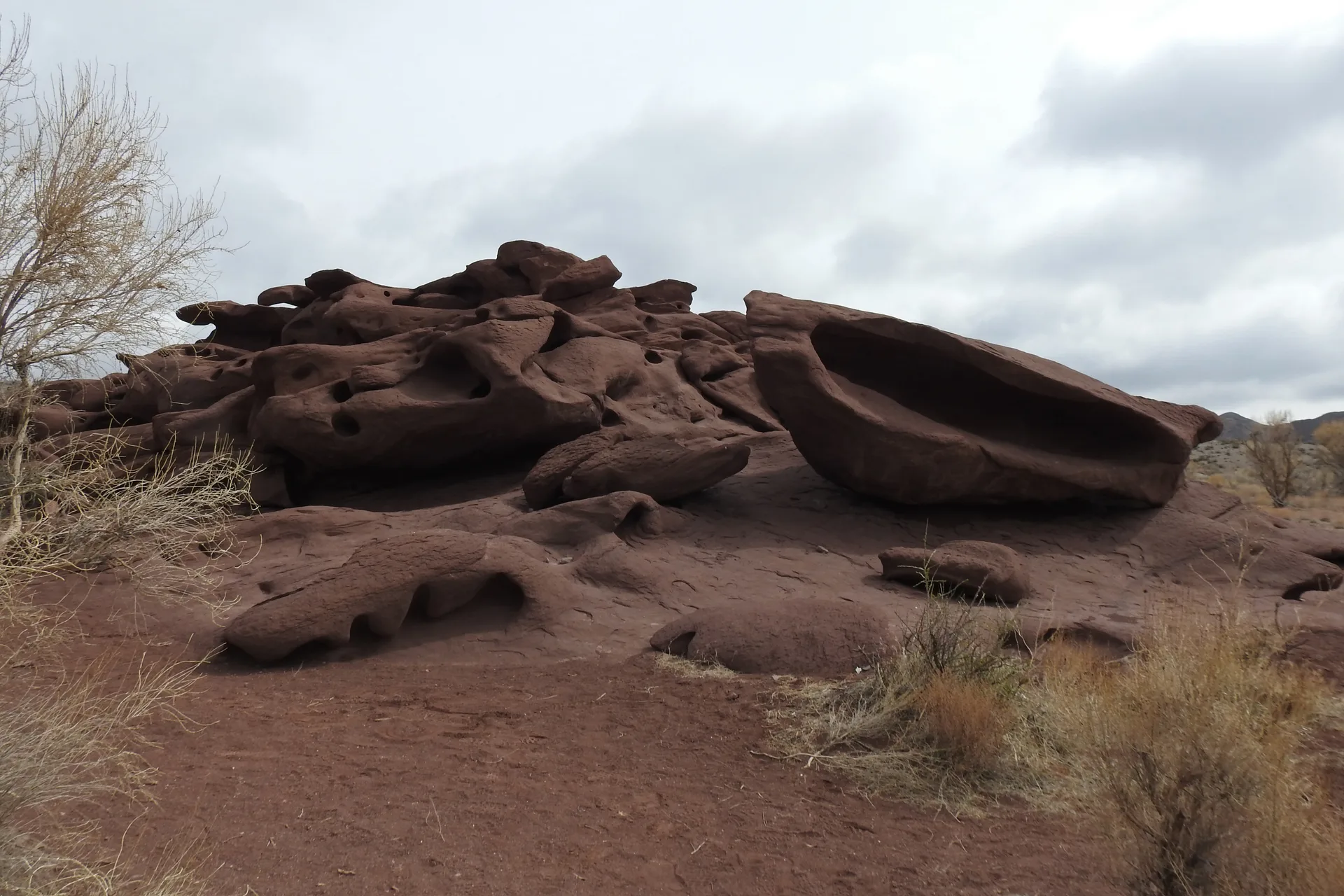
Stop 5
Katutau Mountains
- From previous:
- 30 km · 50 min drive
- Stay:
- ~2 h
Katutau ('Bitter Mountains') is the volcanic counterpart to Aktau's sedimentary world. Ancient eruptions left a field of solidified basalt flows, crumbling lava columns and dark volcanic rock formations that contrast sharply with the pale desert around them. The highest point tops 900 m. The area is less visited than the Singing Dune and rewards explorers willing to scramble across rough ground; park guides can lead 2–3 hour walks through the main lava field. Gazelles and kulans (wild asses) are commonly seen on the steppe approach.
Tip: Katutau involves rough cross-country driving and is best paired with the Aktau visit on day two. Wear sturdy footwear — the volcanic rock is uneven and sharp-edged.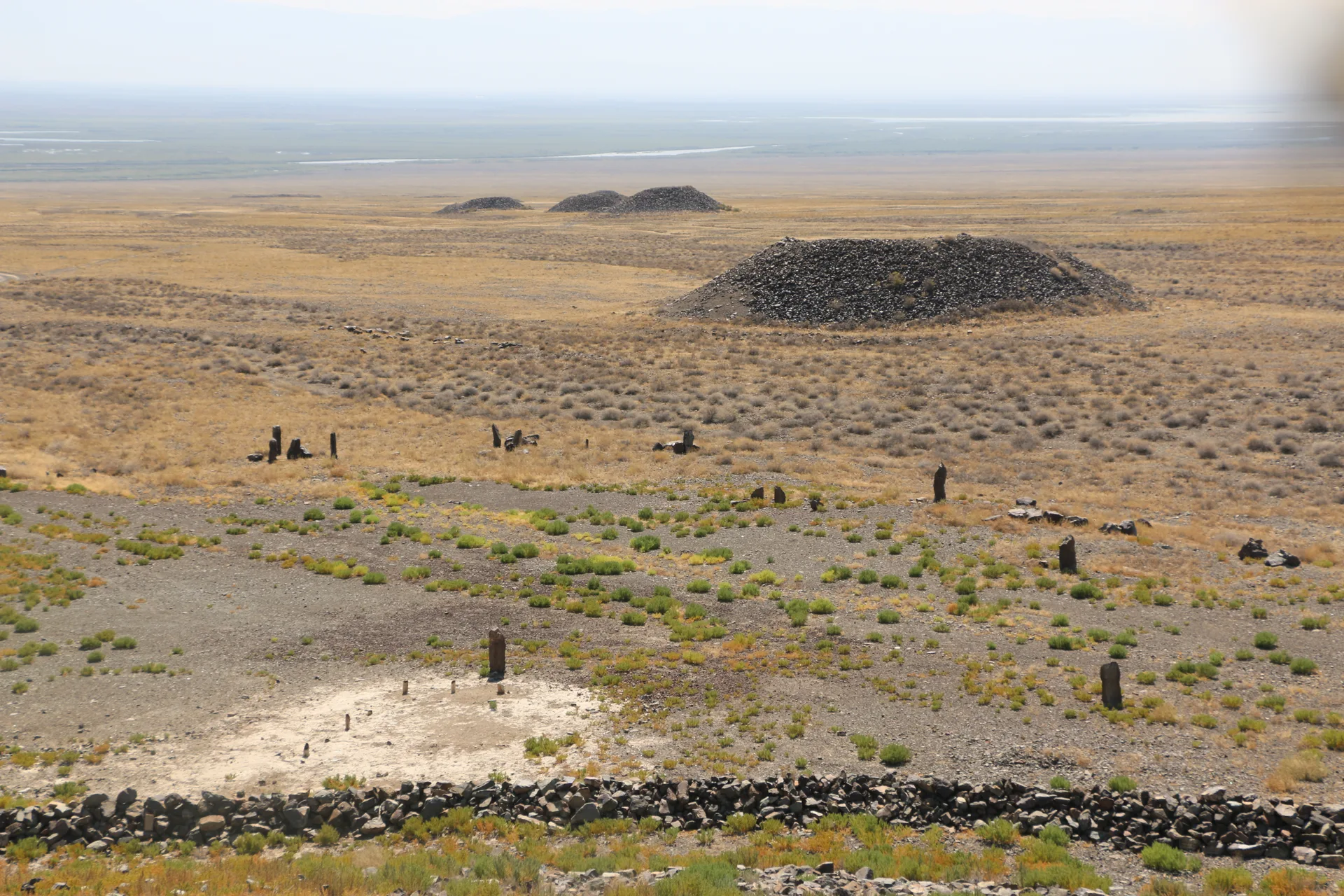
Stop 6
Besshatyr Burial Mounds
- From previous:
- 30 km · 40 min drive
- Stay:
- ~1.5 h
On the right bank of the Ili River, a plain scattered with 31 earthen mounds marks the necropolis of the Semirechye-Saka, nomadic pastoralists who dominated these steppes from the 6th to the 4th century BC. The largest kurgan stands 17 m high with a diameter of 105 m — easily visible from a distance — and the entire site covers roughly 2 km². The mounds are arranged in orderly rows running north to south. Ritual altar stones on the eastern faces reflect a Saka sun-cult. Gold artefacts, weapons and elaborate animal-style ornaments were recovered during Soviet-era excavations; replicas are displayed at the Kazakh Museum of Arts in Almaty. UNESCO's 2023 World Heritage nomination for the broader Saka burial complex brought renewed attention to the site.
Tip: Besshatyr is on the route back toward the park's western exit near Shengeldy — it pairs well with a return to Almaty via the western checkpoint on day two, cutting roughly 40 km off the backtrack through Basshi. Confirm this exit route with your guide at permit registration, as it requires a separate stamp.
Night 1 of 1 · after Step 2: Basshi Village — Park Headquarters
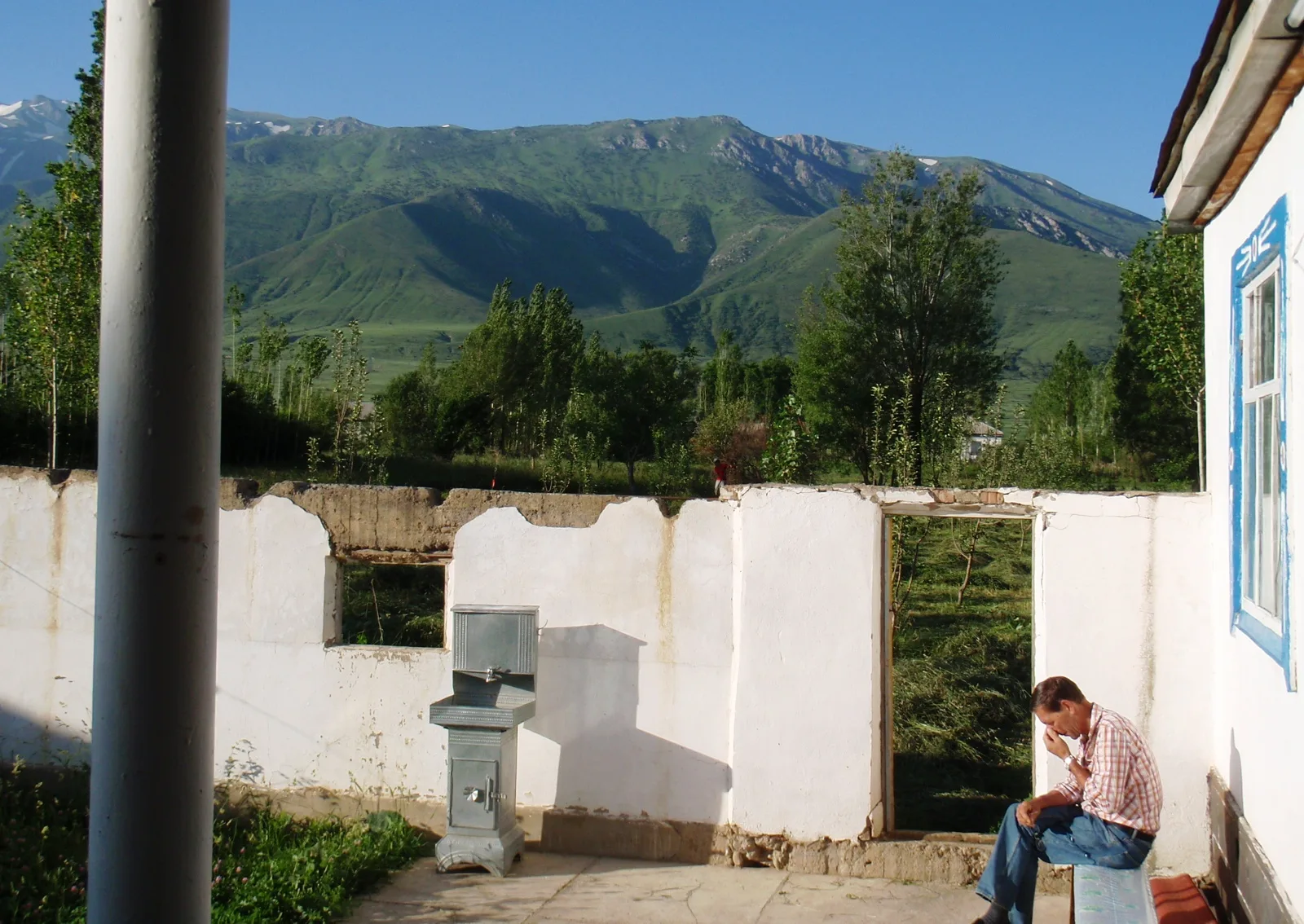
Gostinitsa Altyn-EmelГостиница Алтын Эмель
The main village guesthouse in Basshi, run out of a compact one-storey building 300 m from the park headquarters. Rooms are basic — two or three metal-frame beds, a shared WC, and a small yard — but the hosts include three meals in the rate and will pack a box lunch on request. Electricity runs on a generator that powers down around 22:00, so bring a headlamp.
- breakfast
- dinner
- packed lunch on request
- parking
6–8 beds across 3 rooms
Also nearby
Kerey Eco-CampYurt campMid-range· breakfast
Kerey Eco-CampЭко-лагерь Керей
A small yurt camp set 1 km north of Basshi on the edge of the Taukum sand desert, operated by a local family during the spring-to-autumn season. Four traditional felt yurts sleep two to three guests each; shared toilet and cold-water washbasin in a separate outbuilding. Breakfast and a campfire dinner come with the rate, and the family can arrange a park guide for the next morning's route.
- breakfast
- campfire
- dinner
- guide arrangement
- parking
4 yurts, 2–3 guests each (8–12 total)
What to bring
- Water (minimum 5 L per person per day)
- Cash (KZT) — no ATMs or card readers
- Offline GPS maps (2GIS or Maps.me, downloaded before leaving Almaty)
- Sun hat and high-SPF sunscreen
- Sturdy closed-toe shoes for dune and rock scrambling
- Warm layer for evenings (desert temperatures drop sharply after dark)
- Full spare tyre plus tyre repair kit
- Snacks and packed meals (no shops inside the park)
- First-aid kit
- Headlamp or torch
- Dust-proof bags for cameras and electronics
- Insect repellent (spring/summer)
Sources
Researched from English and Russian sources. Inaccuracies are mine.
- https://en.wikipedia.org/wiki/Altyn-Emel_National_Park
- https://ru.wikipedia.org/wiki/%D0%90%D0%BB%D1%82%D1%8B%D0%BD-%D0%AD%D0%BC%D0%B5%D0%BB%D1%8C
- https://en.wikipedia.org/wiki/Besshatyr_Burial_Ground
- https://en.wikipedia.org/wiki/Aktau_Mountains
- https://altynemel.kz/index.php/en/about-the-park/location
- https://www.backpackadventures.org/altyn-emel-national-park/
- https://rootsabroadtravel.com/altyn-emel-national-park-kazakhstan/
- https://wondersandwaves.de/en/2025/10/21/1-day-in-altyn-emel-national-park-your-complete-self-drive-guide/
- https://zabugorshiki.com/altyn-emel/
- https://caravanistan.com/kazakhstan/almaty-region/altyn-emel-national-park/
Similar trips
2 days
Assy Plateau
A vast high-altitude grassland at 2100–2800 m, reached via the Turgen Gorge east of Almaty — home to nomad summer camps, an active astrophysical observatory, and skies clear enough to see the Milky Way with the naked eye.
2 days
Kaindy Lake
A 400-metre alpine lake where the trunks of drowned spruce trees still stand decades after a 1911 earthquake dammed the valley, their pale masts rising from water so cold it barely reaches 6°C in summer.
Day trip
Tuyuk-Su Glacier
A drive-and-hike day trip into the upper Malaya Almatinka gorge, climbing 1,250 m from the Shymbulak resort to the Tuyuk-Su glacier terminus at 3,400 m — one of the few Tien Shan glaciers with an unbroken mass-balance record since 1957.